One supplier, clearer accountability: simplifying technical building maintenance
When HVAC, electrical and refrigeration issues overlap, fragmented maintenance can slow everything down. A more integrated approach gives property teams clearer communication, faster diagnosis and fewer gaps.
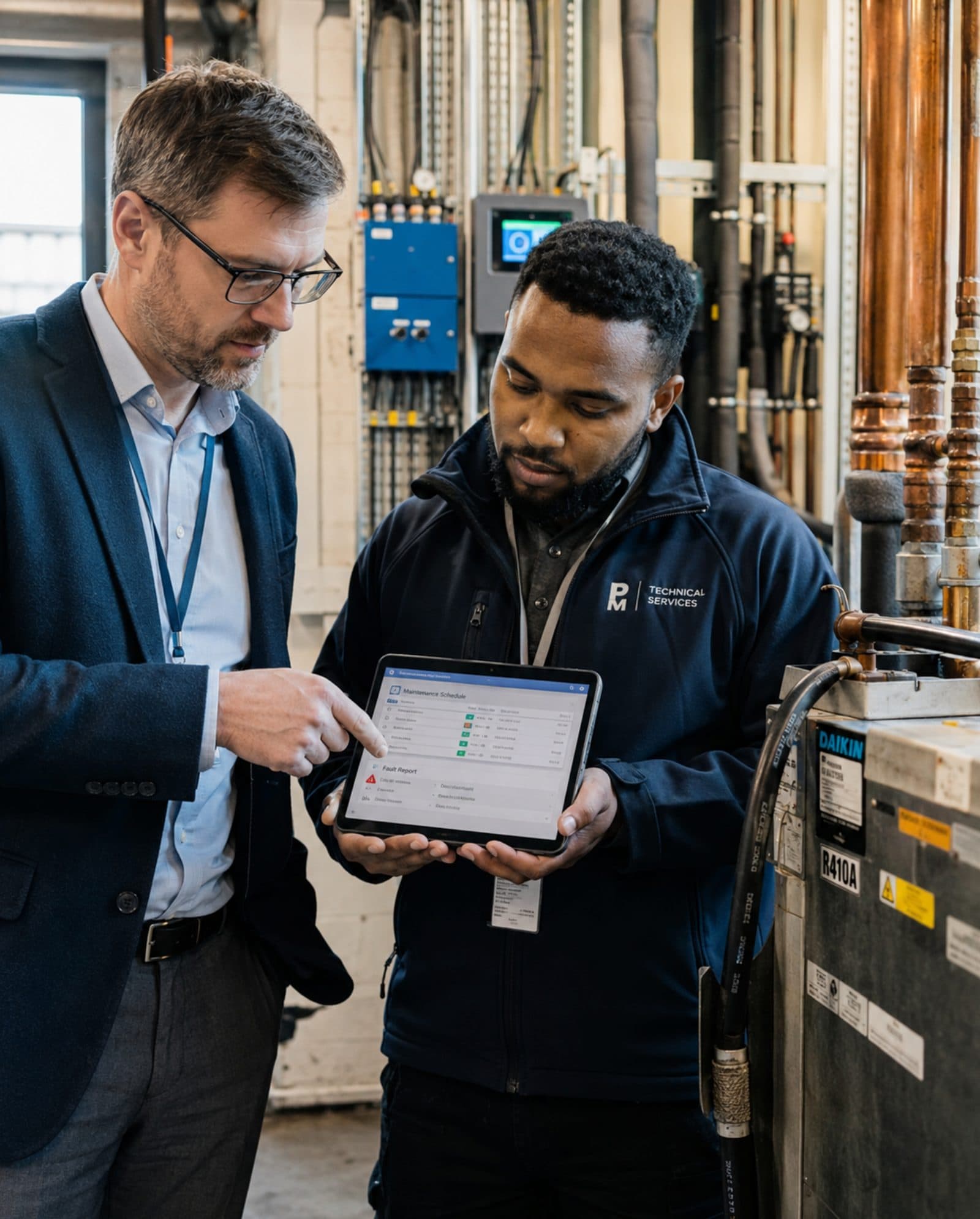
If you have ever had to chase three different contractors for one building issue, you will know that the real problem is often not the fault itself. It is the time lost trying to get everyone aligned.
A tenant reports that an area of a building is too warm. An HVAC fault is logged. Then someone suspects the issue could be electrical. Refrigeration may also need to be checked, depending on the system and the building use. By the time each supplier has attended, assessed their part and reported back separately, the tenant is still waiting, the pressure on the property team has increased, and nobody has a complete view of what happened first.
This is a familiar challenge in building maintenance. Technical systems do not always fail neatly within one category. Heating, cooling, ventilation, electrical supply, controls and refrigeration can be closely connected. When they are managed in isolation, a relatively simple problem can become harder to diagnose, harder to communicate and harder to prevent from recurring.
That is where integrated technical support can make a meaningful difference.
The hidden cost of fragmented maintenance
In many buildings, maintenance responsibilities are divided between several specialist contractors. There may be one provider for HVAC, another for electrical works and another for industrial refrigeration or cold systems. This can work well when tasks are clearly separate. However, faults in operational buildings are not always so straightforward.
A system may stop performing correctly because of a mechanical issue. Or it may be affected by an electrical fault, a controls problem, poor airflow, incorrect settings or wear in a related component. If every discipline is assessed separately, the property manager or building administrator can end up acting as the link between technical teams.
That creates several practical difficulties.
First, there is delay. Each contractor may need to visit the site separately, review the issue, prepare feedback and wait for the next step. Even when everyone is responsive, the sequence can take longer than a joined-up assessment.
Second, there is a communication burden. The person managing the building may have to explain the same problem more than once, pass information between suppliers and interpret technical comments from different reports.
Third, accountability can become unclear. If one supplier says the fault sits outside their scope and another has not yet attended, the issue remains unresolved. The building team is left trying to identify who should act next.
Finally, the bigger picture can be missed. A single fault may be fixed, but the underlying cause or pattern may not be properly understood if information is spread across multiple contractors and service histories.
Why one accountable point of contact helps
An integrated approach does not mean that every building needs only one person to solve every problem. Technical maintenance still requires the right expertise. However, having one accountable team or one clear point of contact can simplify the way issues are managed.
For property managers and building administrators, this can bring several advantages.
Faster diagnosis
When HVAC, electrical and refrigeration knowledge is connected, the diagnostic process can be more efficient. Instead of moving step by step between separate contractors, the issue can be considered across related systems from the start.
For example, if a cooling issue may be linked to power supply, controls or refrigeration performance, the investigation can take account of those possibilities in a more coordinated way. This helps reduce unnecessary back and forth and supports a clearer route towards resolution.
Faster diagnosis is not about rushing the work. It is about reducing avoidable waiting time and making sure the right technical questions are asked early.
Better communication between disciplines
Building maintenance depends on good information. A technician may identify a fault, but the value of that diagnosis depends on how clearly it is shared and how well it connects to the next action.
When multiple suppliers are involved, communication can become fragmented. Each contractor may use different reporting formats, different terminology and different assumptions about what has already been checked. This can make it harder for a property team to understand the status of the issue.
A more integrated maintenance model supports better communication between disciplines. Information can be shared more directly, findings can be compared, and recommendations can be presented in a way that is easier for the building team to use.
Less back and forth between suppliers
One of the most frustrating parts of technical maintenance is the repeated handover. A contractor attends, identifies that another trade may be required, and the process begins again. The property manager then has to arrange access, brief the next supplier, manage expectations and wait for another report.
This back and forth can affect tenants, occupants, site staff and management teams. It also uses time that could be spent on planned maintenance, compliance administration, budgeting or other operational priorities.
With one accountable point of contact, the process becomes easier to manage. The building team has a clearer route for logging the issue, receiving updates and understanding what happens next.
More continuity from one visit to the next
Technical buildings benefit from continuity. Every visit adds knowledge: how equipment is performing, which areas have had repeated issues, what temporary measures have been used, and which components may need closer attention.
When maintenance is split between several unrelated providers, that knowledge can become scattered. One supplier may understand part of the system well, while another holds separate notes about a connected issue.
Integrated support helps create a more consistent service history. The team attending the next visit can build on previous findings rather than starting from the beginning. Over time, this can support better planning and more informed decisions.
Clearer reports that can actually be used
Reports are not just paperwork. For property managers and building administrators, they are essential tools for decision-making.
A useful report should explain what was found, what action was taken, what remains to be done and whether there are any recurring risks to monitor. It should be clear enough to support internal communication, budget discussions and future maintenance planning.
When reports come from several suppliers, they may not always fit together. One report might focus only on the HVAC element, another on electrical supply, and another on refrigeration performance. The result can be technically accurate but difficult to interpret as a complete picture.
A connected approach can help provide clearer reporting. It allows findings from related systems to be presented in a more practical way, helping the building team understand both the immediate fault and any wider implications.
Maintenance is about more than fixing faults
For property teams, maintenance is not simply about reacting when something stops working. It is about keeping buildings safe, reliable and predictable to run.
That means reducing avoidable disruption, identifying recurring problems and making informed decisions about repairs, servicing and future investment. It also means giving tenants and occupants confidence that issues are being handled properly.
When electrical, HVAC and refrigeration matters are managed in a more connected way, property managers can spend less time coordinating suppliers and more time managing the building. That does not remove the complexity of technical systems, but it does make the maintenance process easier to control.
Seeing recurring problems more clearly
One of the important benefits of integrated technical support is visibility. A single fault may seem isolated, but repeated issues often tell a bigger story.
If the same type of fault returns after a few months, the question is not only how to repair it again. The more useful question is why it is coming back. Is it connected to usage patterns, system condition, electrical supply, controls, maintenance intervals or another factor?
A fragmented approach can make these patterns harder to spot. Each supplier may only see their own part of the picture. A more joined-up view helps property teams understand whether problems are isolated events or signs of something that needs planned attention.
This can support better budgeting and maintenance planning. It can also help avoid repeatedly dealing with the same disruption without addressing the underlying cause.
A simpler process that is easier to trust
Technical maintenance will always involve specialist knowledge. Buildings are complex, and faults are not always immediately obvious. However, the way maintenance is organised can either add to that complexity or reduce it.
For property managers and building administrators, the value of simpler technical support is practical: fewer gaps, fewer surprises and a clearer process from issue to resolution.
Having one supplier or one accountable point of contact can make it easier to log faults, coordinate attendance, share information, understand reports and plan next steps. It can also help ensure that HVAC, electrical and refrigeration issues are not treated as separate problems when they may be connected.
At MRS Climatización, our work focuses on installations, maintenance and technical solutions across HVAC, electrical and industrial refrigeration. For buildings that depend on reliable technical systems, a coordinated approach can make everyday maintenance more manageable and more transparent.
The aim is not to make building systems seem simple when they are not. It is to make the maintenance process clearer, more connected and easier to trust.
Jason Leven
MRS Climatización